Guides · Highlands Ranch
Sub-Zero Error Code List, Sorted by What You Can Reset Yourself
The Sub-Zero error codes owners meet most are EE, EC40, EC50, a flashing wrench or Service light, Vacuum Condenser, Sh r and double dashes, and only some can be cleared at home. This printable list explains each one and says when a technician is needed.
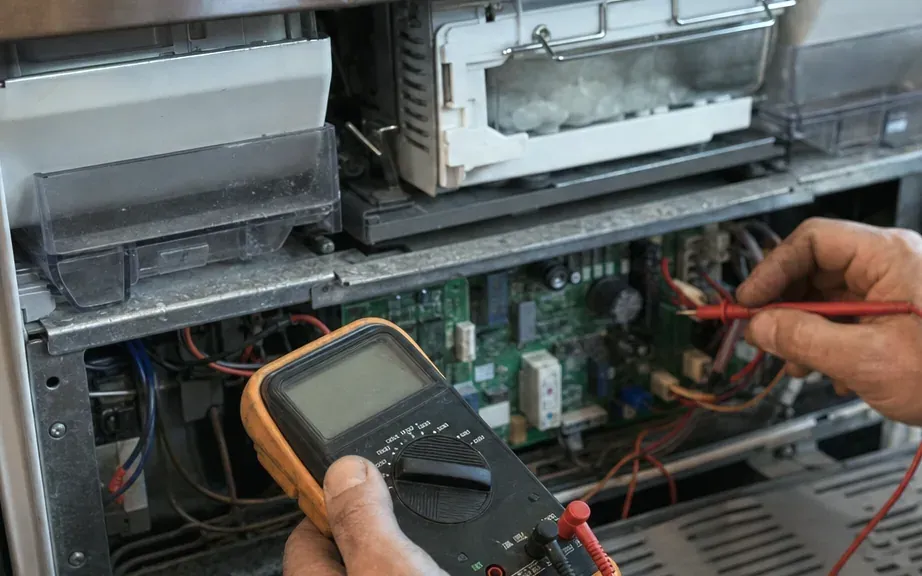
Sub-Zero error codes fall into three piles: codes that mean a part has failed (EE, plus EC40 or EC50 when temperatures keep climbing), codes you can clear after a quick check (EC50 with near-normal temperatures, a flashing Service word, Vacuum Condenser, a flashing ice cube), and displays that only look like faults (Sh r, double dashes, Snooze/Refresh). The list below is arranged by what to do next rather than by model, so you can print it or save it from your browser as a PDF and keep it in a kitchen drawer. Whether you live in Northridge or Eastridge, the dry, dusty air along this part of the Front Range means a clogged condenser sits behind several of these codes, and cleaning one costs nothing.
Work out which control panel you have
Sub-Zero has used several generations of controls, and the same fault looks different on each. Legacy Classic units, whose model numbers start with BI, signal trouble with a small wrench icon. The 600 and 700 Series panels flash the word Service between the two zone temperatures, sometimes beside a code such as EC40. Current Classic (CL) and Designer (DET, DEC) models use touch controls that spell out reminders in words. The model number on the rating tag inside the unit tells you which part of this list applies.
Codes that always need a technician
EE is the plainest one. Paired with a flashing Service light or wrench, it means a thermistor, the small sensor that reports compartment temperature to the control board, has failed. EE on the left half of the display points to the freezer sensor; on the right half, to the refrigerator sensor. Sub-Zero gives owners no steps to try, so there is nothing to reset.
EC40 with Service flashing shows up on 600, 648PRO and 700 Series units when the freezer compressor has run well past normal. A door that did not latch can cause it, and so can a sealed-system leak, a dead fan or a faulty sensor. Sub-Zero draws a useful line: if the freezer reads less than 10° above its setting, clean the condenser and watch it. If it is more than 10° above and the door was shut, schedule service, and do not clear the code while the number is still rising, since the stored fault helps whoever diagnoses it.
On a Legacy Classic (BI), a flashing wrench with the alarm chiming means a major code has been logged. A steady wrench with the chime is a minor fault that is not putting food at risk. Our Sub-Zero refrigerator and freezer repair page explains what a diagnosis covers.
Codes you can usually clear after a check
EC50 is the fresh-food twin of EC40: the refrigerator compressor has run too long. If that side is holding close to its set point, clean the condenser, then press and hold the bell key, the door-ajar alarm button, for 15 seconds. If the compartment is warm, skip the reset and call.
When Service flashes by itself on a 600 or 700 Series panel, Sub-Zero again blames excess compressor running. With temperatures near normal, clean the condenser, then switch the unit’s breaker in the home’s panel off for 30 seconds and back on.
A flashing Vacuum Condenser message means the unit is straining or running warm, from a dirty condenser, a door that is not sealing, or a fault inside the unit. Turn it off, vacuum the fins with a soft brush attachment, then switch it back on to reset the message. If it returns soon after, a gasket or fan is the next suspect.
On a Classic (BI), one ice cube icon flashing with no alarm means the ice maker’s water valve stayed open too long, so the control shut the ice maker down to prevent a flood. Make sure the supply shutoff is fully open and the line is not kinked, then hold Alarm until CFC (Clear Fault Codes) appears. If it trips again, the valve or fill tube needs our Sub-Zero ice maker repair service.
If a Classic (BI) alarm keeps chiming while you sort things out, press ALARM and POWER together and release both in less than 5 seconds. That hides the warning for 24 hours; it fixes nothing.
Displays that look like faults but are settings
Sh r on a Classic (BI) display means Showroom Mode, where the unit will not cool. To leave it, press Power to switch off, hold a Warmer and Colder key pair, press Power, then let go of all three. On current Classic and Designer models, a display reading 38° and 0° while the unit stays warm may mean the same mode is on, and Sub-Zero asks owners to phone its customer care line.
Double dashes where a temperature belongs mean that zone was switched off. To bring it back, shut the whole unit down with Power, keep your finger on the Warmer key for the dark zone, and press Power once more.
Snooze/Refresh on a Classic (CL) or Designer (DET, DEC) panel says the water filter or air purification cartridge is due. Snooze delays the reminder 24 hours, and each new part restarts its cycle for about one year. If the interior lights on those models go dark, a door or drawer was probably left open and the control cut the lights to limit heat; close it and wait one hour before calling.
One ice cube icon just means the ice maker is on; three mean Max Ice is running. On the UC-15I undercounter ice maker, REPLACE FILTER glows red after 8000 ice-making cycles. Fit the new filter, then touch and hold CLEAN for 6 seconds.
Dust, water and Highlands Ranch kitchens
Fine dust settles in condenser fins in Southridge and BackCountry homes alike, and a coated condenser is exactly what EC40, EC50 and Vacuum Condenser are warning about. Water is the other half: Highlands Ranch is supplied by Centennial Water, and how its supply treats filters and valves is covered in what Highlands Ranch water does to your ice.
What a repair costs once the code is read
Every visit starts with an $89 diagnosis that reads the stored codes and finds the failed part, and the $89 comes off the bill if you approve the work. These are typical ranges, with a firm quote after diagnosis: a sensor, defrost heater or thermostat behind an EE code, $270–$650; an evaporator or condenser fan motor, $340–$730; a door gasket, $300–$630; an ice maker valve or supply line, $290–$840; a control board, $390–$950; compressor or sealed-system work, $1,460–$3,340. Even that last figure sits well below the price of a comparable new built-in. Have the code and model number ready when you call (720) 815-9150.
Questions
What are the most common Sub-Zero error codes?
The ones owners report most are EE, a failed temperature sensor, and EC40 or EC50, which flag a freezer or refrigerator compressor that has run too long. A flashing wrench or Service light means a fault was logged. Vacuum Condenser, Sh r and double dashes also appear, but those usually point to cleaning or a setting rather than a broken part.
Is there a Sub-Zero error code list PDF I can keep?
This page works as one: print it, or save it as a PDF from your browser, and keep it with the appliance paperwork. The use and care guide that came with your unit describes its own display, so file the two together and you have both the model detail and a quick sheet sorted by what to do next.
What does Sub-Zero service code EC50 mean?
EC50 means the refrigerator compressor has been running far longer than it should. If the fresh-food side is close to its set temperature, clean the condenser, then hold the bell key, the door-ajar alarm button, for 15 seconds to clear it. If the compartment is warm, leave the code in place and book service.
Why is the wrench icon flashing on my Sub-Zero?
On a Legacy Classic (BI) unit, a flashing wrench with the alarm chiming means a major error code has been stored and a technician should look at it. A steady wrench with the chime marks a minor fault that is not threatening temperatures, so it is less urgent.
Why is my Sub-Zero not cooling when no error code shows?
Look first for Sh r, or for 38° and 0° on a newer Classic or Designer unit, because Showroom Mode keeps the display lit while the unit does not cool. If neither appears, a dusty condenser, a tired door gasket or a failing fan are the usual causes, and an $89 diagnostic visit pins down which one.
How much does a Sub-Zero repair cost after an error code?
It depends on the part the code leads to: a sensor or defrost part typically comes to $270–$650, a control board $390–$950 and an ice maker valve or supply line $290–$840. Each job begins with an $89 diagnosis, and that amount is deducted from the bill when you approve the repair.